Platypwn – Cognitive Reminder Call
The server seems to be forgetful :( Can you help it remember?

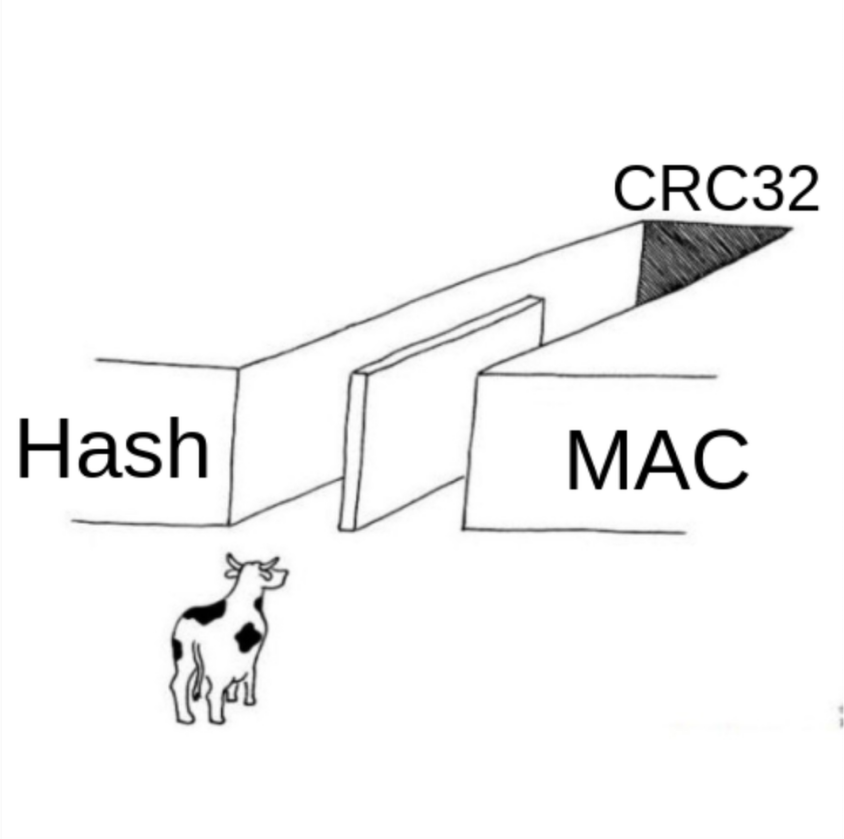
Cognitive Reminder Call
Category: Crypto
Prompt: The server seems to be forgetful :( Can you help it remember? Artifact: ⬇️ crypto.cognitivereminder.zip
Flag format:PP{...}
Intro
CRC32 is a checksum, not a secure MAC. This challenge abuses CRC32 as an authenticator over key || nonce || message and then asks us to “remind” the server of its key via four CRC32 values of unknown 4‑byte chunks. Because CRC32 is linear over GF(2) and supports combine/uncombine, we can recover CRC32(key) from any authenticated sample and forge a valid tag for our chosen nonce and parts. Those parts also derive the AES key used to encrypt the flag, so we can decrypt the reward locally.
Challenge Description
The service prints a previously-encrypted flag (AES‑CBC), then three “authenticated” log lines each with a tag (CRC32) and nonce, and finally a list of 4 target CRC32 integers (the “cognitive reminders”). We must supply four 4‑byte parts whose CRC32s match the given integers, plus a fresh nonce and a tag for the concatenation to pass the MAC check.
Key observations:
- The MAC is
tag = CRC32(key || nonce || parts_concat). - CRC32 has a public combine operation:
CRC32(A || B) = combine(CRC32(A), CRC32(B), len(B)). - Hence we can uncombine to extract
CRC32(key)from any authenticated(nonce, message, tag)sample printed by the server. - Because CRC32 on 4 bytes is a full‑rank linear map, each target CRC32 admits a unique 4‑byte preimage we can compute algebraically.
Exploit Strategy
- Parse any previously printed authenticated line, compute
crc_msg = CRC32(nonce || message), then recovercrc_key = uncombine(tag, crc_msg, len(nonce||message)). - For each target integer
Tᵢ, compute a 4‑byte stringPᵢsuch thatCRC32(Pᵢ) = Tᵢ(solve a 32×32 system over GF(2) once and reuse its inverse). - Pick a new nonce
N. Buildpayload = N || P₁||P₂||P₃||P₄and forge a valid tag viatag* = combine(crc_key, CRC32(payload), len(payload)). - Send
P₁..P₄,N, andtag*. The service returns an AES‑CBC ciphertext of the real flag where the key isSHA256(P₁||P₂||P₃||P₄)and IV = first 16 bytes of the ciphertext. Decrypt locally to getPP{...}.
Steps
- Given reminders (example from our run):
[1947904649, 2450251710, 1330652206, 255696126]
we solved for 4‑byte parts:P1 = 517d2bcbP2 = 9c0dd2d9P3 = 8e2c6af5P4 = 54eedab9
- Chose fresh nonce:
00112233 - Forged tag (CRC32 over
nonce || parts_concatcombined withCRC32(key)):f43f588e
nc -v 10.80.16.59 1337:
1
2
3
4
5
6
7
8
9
Part 1 (hex): 517d2bcb
Part 2 (hex): 9c0dd2d9
Part 3 (hex): 8e2c6af5
Part 4 (hex): 54eedab9
nonce (hex): 00112233
tag of the concatenation (hex): f43f588e

Thanks for reminding me! Here is a reward:
efe0e575cae1b7340018de94009445497f4d239fb7c2a91706e1145ea033cfad53bfd7395e3002c9d2199860096bd55ccee70e3c1ed2e59989f7b3bc25a72d93f764d7552174e2d6d688acd776381dd3
- Decrypt
rewardwithAES‑CBCusing keySHA256(P1||P2||P3||P4)and IV = first 16 bytes. - Strip PKCS#7 padding → obtain the flag.
Solver
1
2
3
4
5
6
7
8
9
10
11
12
13
14
15
16
17
18
19
20
21
22
23
24
25
26
27
28
29
30
31
32
33
34
35
36
37
38
39
40
41
42
43
44
45
46
47
48
49
50
51
52
53
54
55
56
57
58
59
60
61
62
63
64
65
66
67
68
69
70
71
72
73
74
75
76
77
78
79
80
81
82
83
84
85
86
87
88
89
90
91
92
93
94
95
96
97
98
99
100
101
102
103
104
105
106
107
108
109
110
111
112
113
114
115
116
117
118
119
120
121
122
123
124
125
126
127
128
129
130
131
132
133
134
135
136
137
138
139
140
141
142
143
144
145
146
147
148
149
150
151
152
153
154
155
156
157
158
159
160
161
162
163
164
165
166
167
168
169
170
171
172
173
174
175
176
177
178
179
180
181
182
183
184
185
186
187
188
189
190
191
192
193
194
195
196
197
198
199
200
201
202
203
204
205
206
207
208
209
210
211
212
213
214
215
216
217
218
219
220
221
222
223
224
225
226
227
228
229
230
231
232
233
234
235
236
237
238
239
240
241
242
243
244
245
246
247
248
249
250
251
252
253
254
255
256
257
258
259
260
261
262
263
264
265
266
267
268
269
270
271
272
273
274
275
276
277
278
279
280
281
282
283
284
285
286
287
288
289
290
291
292
293
294
295
296
297
298
299
300
301
302
303
304
305
306
307
308
309
310
311
312
313
314
315
316
317
318
319
320
321
322
323
324
325
326
327
328
329
330
331
332
333

#!/usr/bin/env python3

import os
import re
import sys
import time
import socket
import hashlib
import zlib

# ---------------- Config ----------------
HOST = sys.argv[1] if len(sys.argv) >= 2 else "10.80.16.59"
PORT = int(sys.argv[2]) if len(sys.argv) >= 3 else 1337

# -------------- CRC32 Algebra --------------
# Standard zlib CRC32 (poly 0xEDB88320, init 0xFFFFFFFF, final ^0xFFFFFFFF)
def crc32_int(data: bytes) -> int:
    return zlib.crc32(data) & 0xFFFFFFFF

def gf2_matrix_times(mat, vec):
    s = 0
    i = 0
    while vec:
        if vec & 1:
            s ^= mat[i]
        vec >>= 1
        i += 1
    return s & 0xFFFFFFFF

def gf2_matrix_square(mat):
    sq = [0]*32
    for n in range(32):
        sq[n] = gf2_matrix_times(mat, mat[n])
    return sq

def gf2_mat_mul(A, B):
    C = [0]*32
    for j in range(32):
        C[j] = gf2_matrix_times(A, B[j])
    return C

def gf2_identity():
    cols = [0]*32
    for i in range(32):
        cols[i] = 1 << i
    return cols

def build_zeros_operator(len2):
    # Build the 32x32 operator that advances CRC by len2 zero bytes (zlib style)
    if len2 <= 0:
        return gf2_identity()
    odd = [0]*32
    odd[0] = 0xEDB88320  # reversed poly
    row = 1
    for n in range(1, 32):
        odd[n] = row
        row <<= 1
    even = gf2_matrix_square(odd)
    odd = gf2_matrix_square(even)
    E = gf2_identity()
    L = len2
    while True:
        even = gf2_matrix_square(odd)
        if (L & 1):
            E = gf2_mat_mul(even, E)
        L >>= 1
        if L == 0:
            break
        odd = gf2_matrix_square(even)
        if (L & 1):
            E = gf2_mat_mul(odd, E)
        L >>= 1
        if L == 0:
            break
    return E

def invert_matrix_gf2(cols):
    # cols: 32 columns (each 32-bit int). Return inverse as columns.
    rows = [0]*32
    for r in range(32):
        bit = 1 << r
        v = 0
        for c in range(32):
            if cols[c] & bit:
                v |= (1 << c)
        rows[r] = v
    inv_rows = [1 << r for r in range(32)]
    for col in range(32):
        piv = None
        for r in range(col, 32):
            if (rows[r] >> col) & 1:
                piv = r; break
        if piv is None:
            raise RuntimeError("non-invertible matrix")
        if piv != col:
            rows[col], rows[piv] = rows[piv], rows[col]
            inv_rows[col], inv_rows[piv] = inv_rows[piv], inv_rows[col]
        for r in range(32):
            if r != col and ((rows[r] >> col) & 1):
                rows[r] ^= rows[col]
                inv_rows[r] ^= inv_rows[col]
    inv_cols = [0]*32
    for c in range(32):
        colbits = 0
        for r in range(32):
            if (inv_rows[r] >> c) & 1:
                colbits |= (1 << r)
        inv_cols[c] = colbits
    return inv_cols

def crc32_combine(crc1, crc2, len2):
    # zlib-style combine: CRC(A||B) from CRC(A), CRC(B), |B|
    E = build_zeros_operator(len2)
    return (gf2_matrix_times(E, crc1) ^ crc2) & 0xFFFFFFFF

def crc32_uncombine(crc_ab, crc_b, len_b):
    # Recover CRC(A) given CRC(A||B), CRC(B), |B|
    E = build_zeros_operator(len_b)
    Einv = invert_matrix_gf2(E)
    x = (crc_ab ^ crc_b) & 0xFFFFFFFF
    return gf2_matrix_times(Einv, x) & 0xFFFFFFFF

# Precompute linear map for 4-byte CRC preimage
_STATE_ZERO = (crc32_int(b'\x00'*4) ^ 0xFFFFFFFF)
_cols = []
for i in range(32):
    basis = (1 << i).to_bytes(4, 'little')
    delta = (crc32_int(basis) ^ 0xFFFFFFFF) ^ _STATE_ZERO
    _cols.append(delta)
_INV_COLS = invert_matrix_gf2(_cols)

def crc32_preimage_4bytes(target_crc: int) -> bytes:
    desired_state = target_crc ^ 0xFFFFFFFF
    delta_target = desired_state ^ _STATE_ZERO
    x_bits = 0
    for i in range(32):
        if (delta_target >> i) & 1:
            x_bits ^= _INV_COLS[i]
    return x_bits.to_bytes(4, 'little')

# -------------- AES-CBC helpers --------------
def aes_cbc_decrypt(key: bytes, ct: bytes) -> bytes:
    iv, data = ct[:16], ct[16:]
    try:
        from Crypto.Cipher import AES  # pycryptodome
        return __import__("Crypto.Cipher.AES", fromlist=["AES"]).AES.new(key, __import__("Crypto.Cipher.AES", fromlist=["AES"]).AES.MODE_CBC, iv).decrypt(data)
    except Exception:
        try:
            from cryptography.hazmat.primitives.ciphers import Cipher, algorithms, modes
            cipher = Cipher(algorithms.AES(key), modes.CBC(iv))
            dec = cipher.decryptor()
            return dec.update(data) + dec.finalize()
        except Exception as e:
            raise SystemExit("[-] Need 'pycryptodome' or 'cryptography' for AES: " + str(e))

def pkcs7_unpad(b: bytes) -> bytes:
    n = b[-1]
    if n == 0 or n > 16 or b[-n:] != bytes([n])*n:
        raise ValueError("Bad PKCS#7")
    return b[:-n]

# -------------- Networking --------------
def sendline(sock: socket.socket, s: str):
    if not s.endswith("\n"):
        s += "\n"
    sock.sendall(s.encode())

def recv_until(sock: socket.socket, pat: bytes, hard_timeout=30.0) -> bytes:
    sock.settimeout(5.0)
    buf = b""
    t0 = time.time()
    while time.time() - t0 < hard_timeout:
        try:
            chunk = sock.recv(4096)
        except socket.timeout:
            chunk = b""
        if not chunk:
            time.sleep(0.05)
            continue
        buf += chunk
        if pat in buf:
            return buf
    return buf

# -------------- Parsing helpers --------------
NOTE_RE = re.compile(
    r"Note: This message was sent over an authenticated channel\. Its tag is ([0-9a-fA-F]+) with nonce ([0-9a-fA-F]+)\."
)

def parse_banner_for_samples_and_targets(text: str):
    """
    Returns:
      samples: list of dicts { 'nonce': bytes, 'tag': int, 'msg': bytes }
      targets: List[int] of 4 CRC32 targets
      used_nonces: set of nonce bytes already seen
    """
    lines = text.splitlines()
    samples = []
    used_nonces = set()

    for i, line in enumerate(lines):
        m = NOTE_RE.search(line)
        if m:
            tag_hex, nonce_hex = m.group(1), m.group(2)
            tag = int(tag_hex, 16)
            nonce_bytes = bytes.fromhex(nonce_hex)
            used_nonces.add(nonce_bytes)

            # Use the *previous* printed line as the message the note refers to
            msg_line = lines[i-1] if i > 0 else ""
            # Capture it exactly as printed (no trailing newline)
            msg_bytes = msg_line.encode()
            samples.append({"nonce": nonce_bytes, "tag": tag, "msg": msg_bytes})

    # Extract targets from the bracketed list
    m_targets = re.search(r"\[([0-9,\s]+)\]", text)
    if not m_targets:
        raise SystemExit("[-] Could not find the [ ... ] list of CRC32 targets.")
    targets = [int(x.strip()) for x in m_targets.group(1).split(",")]
    if len(targets) != 4:
        raise SystemExit("[-] Expected exactly 4 CRC32 targets, got: %d" % len(targets))
    return samples, targets, used_nonces

def choose_best_sample(samples):
    """
    Prefer the sample whose message line starts with 'Here is the flag:' (most deterministic),
    otherwise just take the first.
    """
    for s in samples:
        if s["msg"].startswith(b"Here is the flag:"):
            return s
    return samples[0]

# -------------- Main solve --------------
def main():
    print(f"[+] Connecting to {HOST}:{PORT} ...")
    s = socket.create_connection((HOST, PORT))

    # Read until the first input prompt: "Part 1 (hex):"
    banner = recv_until(s, b"Part 1 (hex):", hard_timeout=20.0)
    text = banner.decode(errors="ignore")
    # print(text)  # Uncomment for debugging

    samples, targets, used_nonces = parse_banner_for_samples_and_targets(text)
    if not samples:
        raise SystemExit("[-] No authenticated samples found in banner.")

    base = choose_best_sample(samples)
    base_nonce = base["nonce"]
    base_msg = base["msg"]
    base_tag = base["tag"]

    # Compute CRC32(nonce || message) as used by the server
    msg_bytes = base_nonce + base_msg
    crc_msg = crc32_int(msg_bytes)

    # Recover CRC32(key)
    crc_key = crc32_uncombine(base_tag, crc_msg, len(msg_bytes))
    print(f"[+] Recovered CRC32(key) = {crc_key:08x}")

    # Build the 4-byte parts matching the 4 target CRC32 values
    parts = [crc32_preimage_4bytes(t) for t in targets]
    parts_hex = [p.hex() for p in parts]
    print("[+] Parts:", ", ".join(parts_hex))

    # Choose a fresh nonce not seen before
    while True:
        my_nonce = os.urandom(4)
        if my_nonce not in used_nonces:
            break
    nonce_hex = my_nonce.hex()
    print(f"[+] Using fresh nonce = {nonce_hex}")

    # Forge tag for payload = nonce || parts_concat
    payload = my_nonce + b"".join(parts)
    crc_payload = crc32_int(payload)
    forged_tag = crc32_combine(crc_key, crc_payload, len(payload))
    tag_hex = f"{forged_tag:08x}"
    print(f"[+] Forged tag = {tag_hex}")

    # ---- Interact: send values when asked ----
    # We are currently at "Part 1 (hex):"
    sendline(s, parts_hex[0]); time.sleep(0.05)
    recv_until(s, b"Part 2 (hex):", hard_timeout=10.0)

    sendline(s, parts_hex[1]); time.sleep(0.05)
    recv_until(s, b"Part 3 (hex):", hard_timeout=10.0)

    sendline(s, parts_hex[2]); time.sleep(0.05)
    recv_until(s, b"Part 4 (hex):", hard_timeout=10.0)

    sendline(s, parts_hex[3]); time.sleep(0.05)
    recv_until(s, b"nonce (hex):", hard_timeout=10.0)

    sendline(s, nonce_hex); time.sleep(0.05)
    recv_until(s, b"tag of the concatenation", hard_timeout=10.0)

    sendline(s, tag_hex); time.sleep(0.05)

    # Read response; look for reward ciphertext
    out = recv_until(s, b"reward", hard_timeout=10.0)
    text2 = out.decode(errors="ignore")
    # If partial, try a bit more
    if "reward" not in text2:
        more = recv_until(s, b"\n", hard_timeout=3.0).decode(errors="ignore")
        text2 += more

    m = re.search(r"reward:\s*([0-9a-fA-F]+)", text2)
    if not m:
        print(text2)
        raise SystemExit("[-] Could not find reward ciphertext (maybe wrong tag?)")

    ct_hex = m.group(1).lower()
    print(f"[+] Got ciphertext ({len(ct_hex)} hex chars). Decrypting...")

    ct = bytes.fromhex(ct_hex)
    key = hashlib.sha256(b"".join(parts)).digest()
    pt = aes_cbc_decrypt(key, ct)
    try:
        flag = pkcs7_unpad(pt).decode(errors="ignore")
    except Exception:
        flag = pt.decode(errors="ignore")

    print("\nFLAG:", flag.strip())

if __name__ == "__main__":
    try:
        main()
    except KeyboardInterrupt:
        print("\n[!] Aborted by user")
Output:
1
FLAG: PP{h4sh3s_4r3_m0r3_th4n_ch3cksums::4v_sy8-LDgFv}